

How to Prove a Loss of Earnings Claim in Ireland
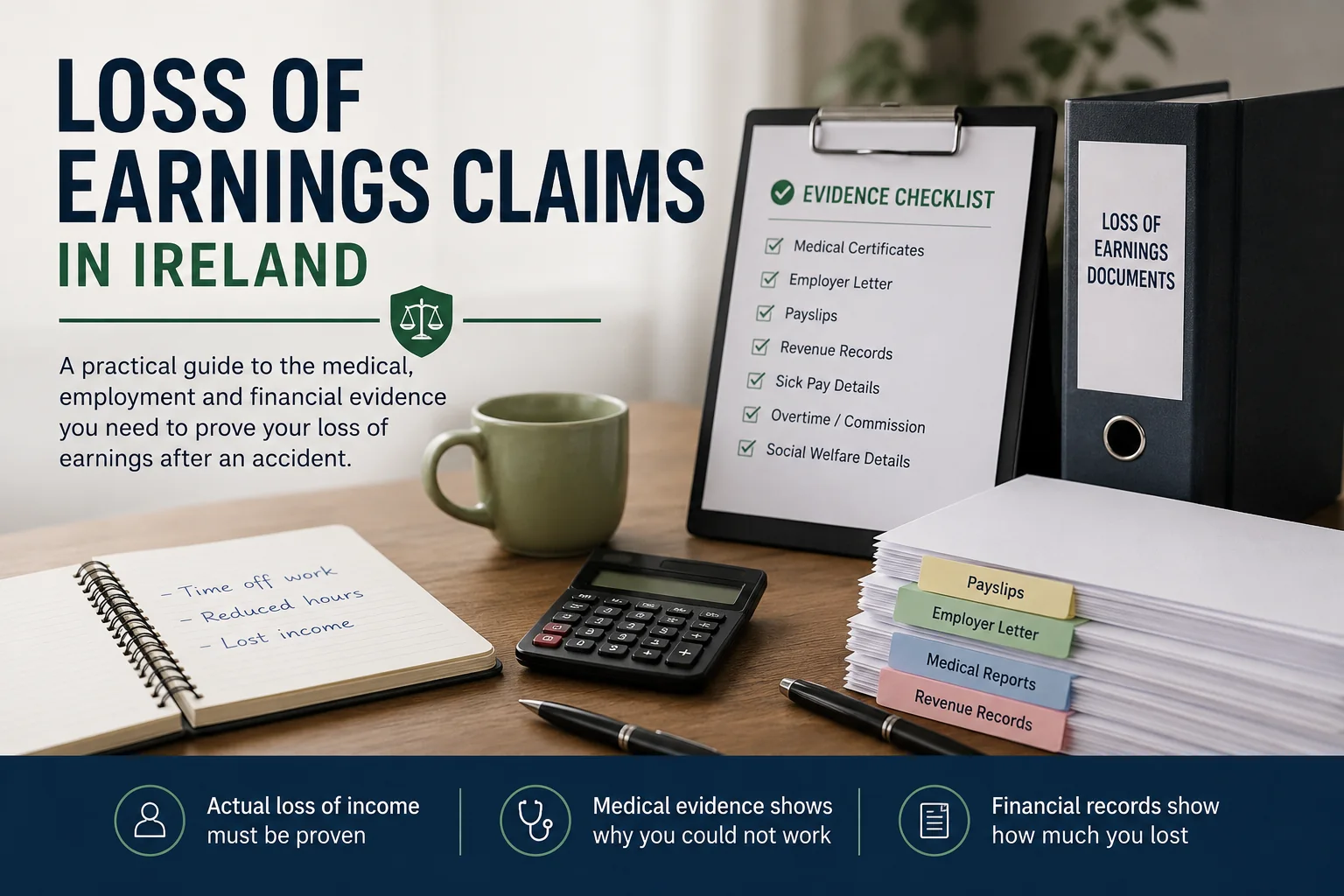
Loss of earnings is not proved simply by showing that you were absent from work. You will normally need to show both that the accident-related injury prevented or restricted you from working and the amount of income that you actually lost.
This guide concerns loss of earnings arising from a personal injury. It does not deal with dismissal, redundancy or other employment-law disputes. Every claim depends on its own medical, employment and financial evidence.
Written and reviewed by Dalippe Lalloo, Solicitor and Principal of Lalloo Solicitors. Last reviewed: 7 August 2026.
Loss of earnings in simple terms
A loss of earnings claim usually comes down to four questions:
- Were you earning an income before the accident?
- Did the accident-related injury prevent you from working, reduce your hours or restrict the work you could do?
- What income did you actually lose after taking account of wages, sick pay and other relevant payments?
- Did you take reasonable steps to return to suitable work or reduce the loss when medically able to do so?
Medical evidence explains why your ability to work was affected. Employment, Revenue, accounting and business records show the amount of the loss. In most cases, both types of evidence are needed.
What is a loss of earnings claim?
A loss of earnings claim is a claim for income lost because an injury affected a person’s ability to work. The Injuries Resolution Board describes loss of earnings as money lost because a claimant was unable to work due to injuries sustained in an accident.
Loss of earnings forms part of special damages. Special damages are financial losses and expenses connected with an accident and injury. They are separate from general damages for pain and suffering. The Personal Injuries Guidelines deal with general damages; they do not set the amount of a person’s actual loss of wages or other vouched financial losses.
Loss of earnings may arise following an accident at work, a road traffic accident, an accident in a public place or another type of personal injury claim.
Past loss of earnings
Past loss of earnings is income already lost between the accident and the date on which the claim is being calculated. It should normally be supported by documents showing the person’s pre-accident income, the period of absence or reduced work and the income actually received during that period.
Future loss of earnings
Future loss of earnings may arise where medical evidence indicates that the injury will continue to reduce a person’s earnings after the claim is resolved. These claims are usually more complex because they depend on future medical, employment and financial assumptions.
Reduced earning capacity
In some cases, a person may return to work but remain at a disadvantage because the injury restricts the type, amount or security of work they can undertake. Whether this gives rise to a recoverable future loss depends on the evidence and the individual circumstances.
Medical evidence and financial evidence do different jobs
Medical evidence explains why you could not work
Medical evidence may include GP certificates, GP and hospital records, consultant reports, occupational-health records and evidence about ongoing restrictions. It should connect the accident-related injury with the period during which the person was fully or partly unable to work.
A basic sick certificate may be useful, but a substantial or disputed claim may require a fuller explanation of the injury, the person’s job, the physical or psychological demands of that job, the period of incapacity and the likely return-to-work position.
Financial evidence shows how much you lost
Financial evidence may include payslips, Revenue records, an employer’s certificate or letter, employment contracts, rosters, overtime records, commission statements, accounts, tax returns and business records.
An employer can confirm that you were absent and what you were paid. A doctor or other appropriate medical professional normally provides the medical evidence explaining why the injury prevented or restricted you from working.
Documents an employee may need
An employee should usually keep or obtain:
- payslips from a reasonable period before the accident;
- payslips covering the period of absence, reduced hours or phased return;
- Employment Detail Summaries from Revenue for the relevant completed tax years;
- current-year pay and tax details reported by the employer to Revenue;
- an employer’s Certificate of Loss of Earnings or a detailed employer letter;
- the dates of complete absence from work;
- details of reduced hours, altered duties or a phased return;
- the employment contract or written terms, where relevant;
- records of normal hours, hourly rates, salary, shift allowances, overtime, commission or bonuses;
- details of wages and contractual or discretionary sick pay actually received;
- details of social welfare payments received during the absence;
- occupational-health reports or return-to-work recommendations, where available;
- correspondence with the employer about duties, hours and return-to-work arrangements.
Revenue states that an Employment Detail Summary contains the income and deduction details reported for each employment or pension for the relevant year and can be downloaded or printed as proof of income. Current-year payroll details reported by an employer can also be viewed through PAYE Services in myAccount.
What should the employer confirm?
A useful employer certificate or letter should be signed, dated and completed by someone who can verify the payroll and attendance records. It may need to confirm:
- the employee’s job title and employment start date;
- the normal working week and rate of pay;
- normal gross and net earnings;
- the date on which the employee stopped work;
- each period of complete absence;
- any period of reduced hours or reduced duties;
- wages, sick pay or other employment payments actually made;
- the normal pattern of overtime, allowances, commission or bonuses;
- whether any overtime or additional work was guaranteed, regular or discretionary;
- the date of return to work;
- details of a phased return or altered duties;
- the employer’s calculation of the earnings shortfall, where it can provide one.
The Injuries Resolution Board’s forms page lists both a Certificate of Loss of Earnings and a Schedule of Special Damages. The precise form or supporting documents required can depend on the stage and circumstances of the claim.
Overtime, shift allowances, bonuses and commission
Income is not limited to a basic salary. Regular overtime, shift allowances, commission or bonuses may be relevant where there is reliable evidence that they would probably have been earned.
Useful evidence may include:
- pre-accident payslips showing a consistent pattern;
- overtime rosters or timesheets;
- commission statements or sales records;
- bonus schemes and previous bonus payments;
- confirmation from the employer;
- records showing how comparable employees were paid during the same period.
A regular and documented pattern is generally easier to establish than a possible opportunity to work additional hours. Speculative overtime, promotion or bonus claims may be challenged.
What if the employer paid full or partial sick pay?
A claim is based on the financial loss actually caused by the injury. A person who continued to receive full wages cannot ordinarily claim the same wages again as though no payment had been made.
There may still be a loss where, for example:
- only part of the normal wage was paid;
- sick pay ended before the person could return;
- regular overtime, commission or shift allowances were lost;
- the person used up a contractual sick-pay entitlement;
- hours or duties remained reduced after the return to work;
- there is a properly evidenced pension or other employment-related loss.
The calculation should clearly show the normal income, every payment actually received and the resulting shortfall. The same item of income should not be claimed twice.
How do social welfare payments affect the calculation?
Tell your solicitor about every social welfare payment received during the period of absence, including the exact payment, dates and amounts. Do not assume that every payment is treated in the same way or try to calculate the legal deduction without advice.
Under the Recovery of Benefits and Assistance Scheme, certain specified illness-related social welfare payments may be recovered from the compensator in a personal injury claim. In the circumstances set out by the scheme, the compensator may offset recoverable benefits against compensation for loss of earnings or profits, but not against unrelated heads of damage.
Complete records of the payments are therefore important when the loss is calculated and when a claim is resolved.
How can a self-employed person prove loss of earnings?
A self-employed loss may require more evidence because business turnover, business profit and personal earnings are not the same thing. The fact that a business took in less money after an accident does not, by itself, establish the amount of the proprietor’s personal loss.
Depending on the business and the period involved, relevant documents may include:
- accounts for several relevant years before and after the accident;
- Form 11 tax returns and Notices of Assessment;
- Revenue Online Service records;
- business bank statements;
- invoices, receipts, order books and sales records;
- appointment diaries or job schedules;
- evidence of contracts, projects or bookings cancelled or declined;
- evidence of seasonal or recurring work;
- records of work postponed and completed later;
- details of replacement staff, subcontractors or locums;
- payroll records and invoices for replacement labour;
- details of business expenses that continued during the absence;
- an accountant’s report where the calculation is complex.
The calculation may need to distinguish between lost net profit, continuing expenses, replacement labour, postponed work and changes in the business that were already occurring before the accident.
Where a person trades through a limited company, the company’s turnover or profit is not automatically the same as the individual’s loss of salary or other income. Company accounts, payroll records and accounting evidence may need to be considered separately.
What about income that was not declared for tax?
Section 28 of the Civil Liability and Courts Act 2004 deals specifically with income, profit or gain claimed in a personal injuries action where a tax return was not made or Revenue was not otherwise notified before the hearing. The section provides that such income may be disregarded by the court, unless the court considers that it would be unjust to disregard it in all the circumstances.
Income relied upon in a loss of earnings claim should be disclosed accurately, and the underlying tax position should be addressed with appropriate legal and tax advice.
What should the medical evidence address?
The medical evidence should do more than record that an injury occurred. Where loss of earnings is significant or disputed, it may need to address:
- the nature of the accident-related injury;
- the date on which the person became unfit for work;
- the duties and demands of the person’s actual job;
- why the injury prevented those duties from being performed;
- whether the person was completely or partly unfit;
- whether reduced or alternative duties were medically suitable;
- the period for which absence or restricted work was reasonable;
- the timing and outcome of any attempted return;
- the likely duration of ongoing restrictions;
- the effect of any pre-existing condition.
In a substantial claim, it is important to know whether the treating GP or relevant specialist can support the period of incapacity attributed to the injury. Long gaps in medical attendance, unexplained changes in the period off work or records that do not mention work restrictions may lead to questions that need to be addressed.
What if there was a previous back problem or another medical condition?
A previous medical problem does not automatically prevent a loss of earnings claim. It can, however, make the issue of causation more complicated.
The evidence may need to distinguish between:
- the effect of the accident;
- symptoms or limitations that existed beforehand;
- any temporary aggravation of a previous condition;
- the natural progression of the previous condition;
- other medical or personal reasons for absence from work.
Previous symptoms, treatment, medication and periods of absence should be disclosed accurately. A clear medical history is usually more helpful than allowing a previous condition to emerge unexpectedly later in the claim.
Returning to work and reducing the loss
A claimant is generally expected to act reasonably to reduce an avoidable financial loss. This does not mean returning to work against medical advice or undertaking duties that are unsafe or unsuitable.
Useful records may include:
- medical advice about returning to work;
- occupational-health assessments;
- emails or letters discussing reduced or alternative duties;
- a phased-return plan;
- records of hours actually worked after returning;
- rehabilitation and treatment records;
- applications for suitable alternative work where the former job could not be resumed;
- reasons why a proposed role or duty was not medically suitable.
A failed or partial return to work can itself be important evidence, provided the dates, duties, hours, symptoms and medical advice are recorded.
How is future loss of earnings assessed?
Future loss of earnings is usually considered where the injury is expected to affect work after settlement or trial. It is not normally calculated simply by multiplying the current wage by the number of years to retirement.
Relevant evidence may include:
- medical prognosis and expected work restrictions;
- the person’s age, qualifications and employment history;
- remaining ability to work in the same or another role;
- likely career progression;
- earnings in an alternative occupation;
- labour-market or vocational evidence;
- pension evidence;
- accounting evidence;
- actuarial calculations;
- contingencies such as periods of unemployment, illness or career change.
Medical, vocational, accounting or actuarial evidence may be required in a serious case. The assumptions used must be supported by the facts rather than based on an optimistic or speculative career path.
A simple worked illustration
Assume an employee normally received net pay of €700 per week. During a six-week medically supported absence, the employer paid net sick pay of €300 per week.
| Illustrative item | Amount |
|---|---|
| Normal net weekly pay | €700 |
| Net sick pay actually received | €300 |
| Preliminary weekly shortfall | €400 |
| Preliminary shortfall over six weeks | €2,400 |
This is only a simple illustration, not a legal calculation for any particular claim. Social welfare, overtime, pension loss, taxation records, partial returns, other earnings and the medical evidence may affect the final figure.
Common reasons a loss of earnings claim is challenged
- there is no medical evidence connecting the absence to the accident-related injury;
- the medical evidence does not cover the full period claimed;
- the employer confirms absence but does not confirm the pay received or the actual shortfall;
- payslips, Revenue records or accounts are missing;
- the calculation does not account for sick pay or other earnings;
- overtime, bonuses or promotion prospects are speculative;
- the tax records and the income claimed are inconsistent;
- a pre-existing condition or previous absence has not been explained;
- a self-employed person relies on lost turnover as though it were personal net income;
- there is no evidence of reasonable attempts to return to suitable work;
- future loss is based on assumptions that are not supported by medical or employment evidence.
Loss of earnings checklist for an employee
- Write down the exact dates on which you stopped and resumed work.
- Keep all payslips before, during and after the absence.
- Download the relevant Employment Detail Summaries from Revenue.
- Ask the employer to complete a Certificate of Loss of Earnings or detailed letter.
- Record wages, sick pay, overtime, allowances, commission and bonuses separately.
- Keep all GP certificates and medical reports dealing with work capacity.
- Record every social welfare payment and payment date.
- Keep documents relating to reduced duties or a phased return.
- Update the calculation if further absence or reduced earnings occur.
Loss of earnings checklist for a self-employed person
- Gather accounts and tax returns for the relevant years.
- Keep business and personal banking records separate.
- Identify work that was cancelled, declined, postponed or transferred.
- Keep evidence of replacement labour and the cost of it.
- Record continuing business expenses.
- Preserve invoices, order books, diaries, contracts and booking records.
- Ask an accountant to explain the loss where the figures are not straightforward.
- Keep medical evidence explaining why the business work could not be performed.
Frequently asked questions
Does a GP sick certificate prove the whole claim?
A sick certificate may support the period of absence, but it does not by itself prove the amount of money lost. A substantial or disputed claim may also require fuller medical evidence explaining why the particular work could not be performed.
Can I claim if I have returned to work?
Returning to work does not prevent a claim for income already lost. There may also be an ongoing issue where hours, duties or earnings remain reduced, but this requires supporting evidence.
Can regular overtime be included?
Regular overtime may be relevant where past payslips, rosters and employer evidence show that it would probably have been earned. A merely possible opportunity to work overtime is harder to establish.
What if my employer will not complete the form?
Other records may still help, including payslips, Revenue records, bank statements, attendance records and written correspondence. The appropriate next step depends on the reason the employer will not assist and the stage of the claim.
Do the Personal Injuries Guidelines calculate loss of earnings?
No. The Guidelines concern general damages for pain and suffering. Loss of earnings is a financial loss that must be calculated and supported separately.
Do I need an accountant or actuary?
Not in every case. Straightforward past wage loss may be shown through payroll and medical records. Complex self-employed, pension or future-loss claims may require accounting, vocational or actuarial evidence.
Does contacting Injured.ie create a solicitor-client relationship?
No. A solicitor-client relationship does not arise unless Lalloo Solicitors confirms its appointment in writing.
How Lalloo Solicitors can assist
Lalloo Solicitors can advise on the medical and financial evidence needed for a personal injury claim, the preparation of special damages, loss of earnings, Injuries Resolution Board applications, settlement discussions and court proceedings where required.
For an initial enquiry, provide a short account of the accident, the injury, your job or business, the dates you were unable to work and the documents already available. Do not place detailed medical records, PPS numbers, tax documents or other highly sensitive information in a general website enquiry form.
Contact our office or call 01 664 1800.
Official sources
The following official sources may be useful. They are provided for general information and should not be treated as advice on an individual claim.
- Injuries Resolution Board — Glossary of Terms
- Injuries Resolution Board — Forms, including the Certificate of Loss of Earnings and Schedule of Special Damages
- Injuries Resolution Board — Making a Claim
- Revenue — Employment Detail Summary
- Revenue — View Your Pay and Tax Details
- Department of Social Protection — Recovery of Benefits and Assistance Scheme
- Civil Liability and Courts Act 2004, section 28 — Income Undeclared for Tax Purposes
General information notice: This page is provided for general information only and is not legal advice. Legal advice should be taken in relation to individual circumstances. Injured.ie is operated by Lalloo Solicitors, Alexandra House, 3 Ballsbridge Park, Dublin 4, D04 C7H2. In contentious business, a solicitor may not calculate fees or other charges as a percentage or proportion of any award or settlement.